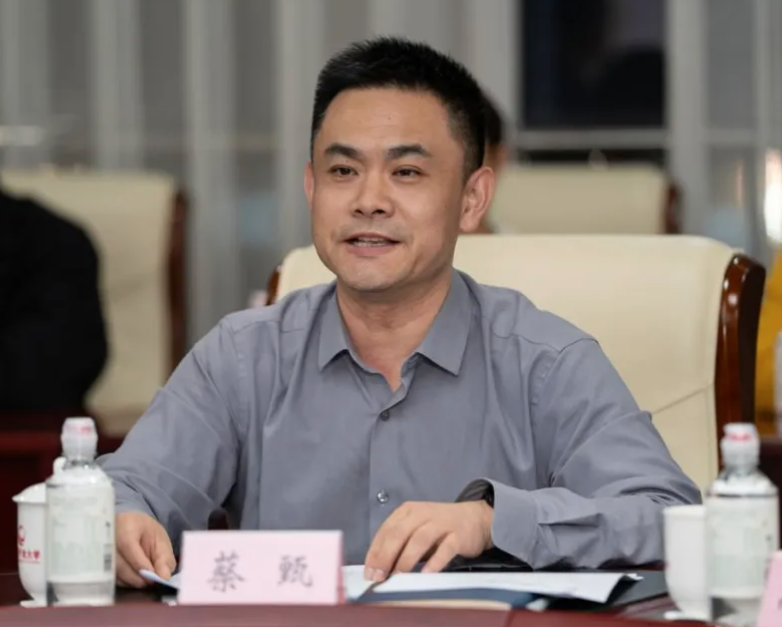
 Beijing 16 April 2026 - The Open University of China’s (OUC) held orientation for Artificial Intelligence (AI) programme and learning project for the spring semester of 2026 was held at the Wukesong Campus. CAI Zhen, OUC Vice President, and GAO Xiaopeng, Head of the AI programme and Professor at Beihang University, attended the event. Student representatives, teacher representatives and staff from university relevant departments participated in person, while over 150 new students joined online.
CAI Zhen extended a warm welcome to the new students. He noted that as a core driving force leading a new round of technological revolution and industrial transformation, AI is profoundly changing the way humans produce and live, and reshaping the ecology of educational development. OUC has consistently taken digital empowerment for lifelong learning and serving the construction of a learning society and a learning powerhouse as its strategic focus, achieving remarkable results in areas such as the development of the AI programme and the application of AI technology to empower education and teaching. In the future, OUC will further enrich its supply of AI education products, build a digitally empowered, agile and flexible teaching model, deepen school-enterprise cooperation, and strengthen collaborative education to create a high-quality lifelong learning platform for students. He encouraged the new students to improve their academic performance in their future learning from the following perspectives. Firstly, to embrace diligent study and critical thinking, persevere in action, and cultivate good habits of lifelong learning Secondly, to ground themselves in practice, integrate knowledge with action, and continuously improve their ability to solve real‑world problems. Thirdly, to help each other, strengthen communication, and grow together through collaborative learning.
GAO Xiaopeng made a detailed presentation on the development strategy of the AI programme, its core educational objectives and scientific learning methods. He encouraged the students to ground themselves on the current AI technology system, focus on improving core competencies, and give priority to developing core qualities that are not easily replaced by technology, such as problem analysis, problem decomposition and value judgment, thereby laying a solid foundation for their future development.
DU Haiyang and LI Zhixiang, Deputy Deans of the Experimental College, respectively gave detailed introductions on the enrolment situation for the AI programme in the spring semester of 2026, subsequent teaching arrangements and relevant management requirements, providing new students with a clear understanding and planning for their professional studies.
Drawing on her own teaching experience, teacher representative WANG Xiajing encouraged everyone to think actively, explore diligently, and provide timely feedback on learning needs. She emphasised the importance of working together with teachers and classmates to optimise course content and improve learning quality. Returning student representative ZHANG Liang shared his valuable experience in balancing work with academic study, offering practical learning references for the new students. New student representatives LIU Sheng, ANWAR Mamatemin and QUAN Wenqi each spoke in turn, sharing their original motivations and expectations for applying to the AI programme. They stated that they would take the start of their studies as a new beginning, diligently explore professional knowledge, refine their professional skills, build a continuously growing knowledge and competency system, and respond to the challenges of the era and realise their self‑worth through lifelong learning.
Looking ahead, the OUC will continue to advance the reform of teaching empowered by AI, deepen innovation in digital and intelligent teaching models, and improve the mechanism for school‑enterprise collaborative education. It aims to build an AI education system oriented towards lifelong learners, and create a new paradigm for talent cultivation that is digitally empowered, agile and flexible, supporting every learner in their growth and development.
Written by TU Chenyang
Photo by ZHAO Hongle
Published: 22 April 2026