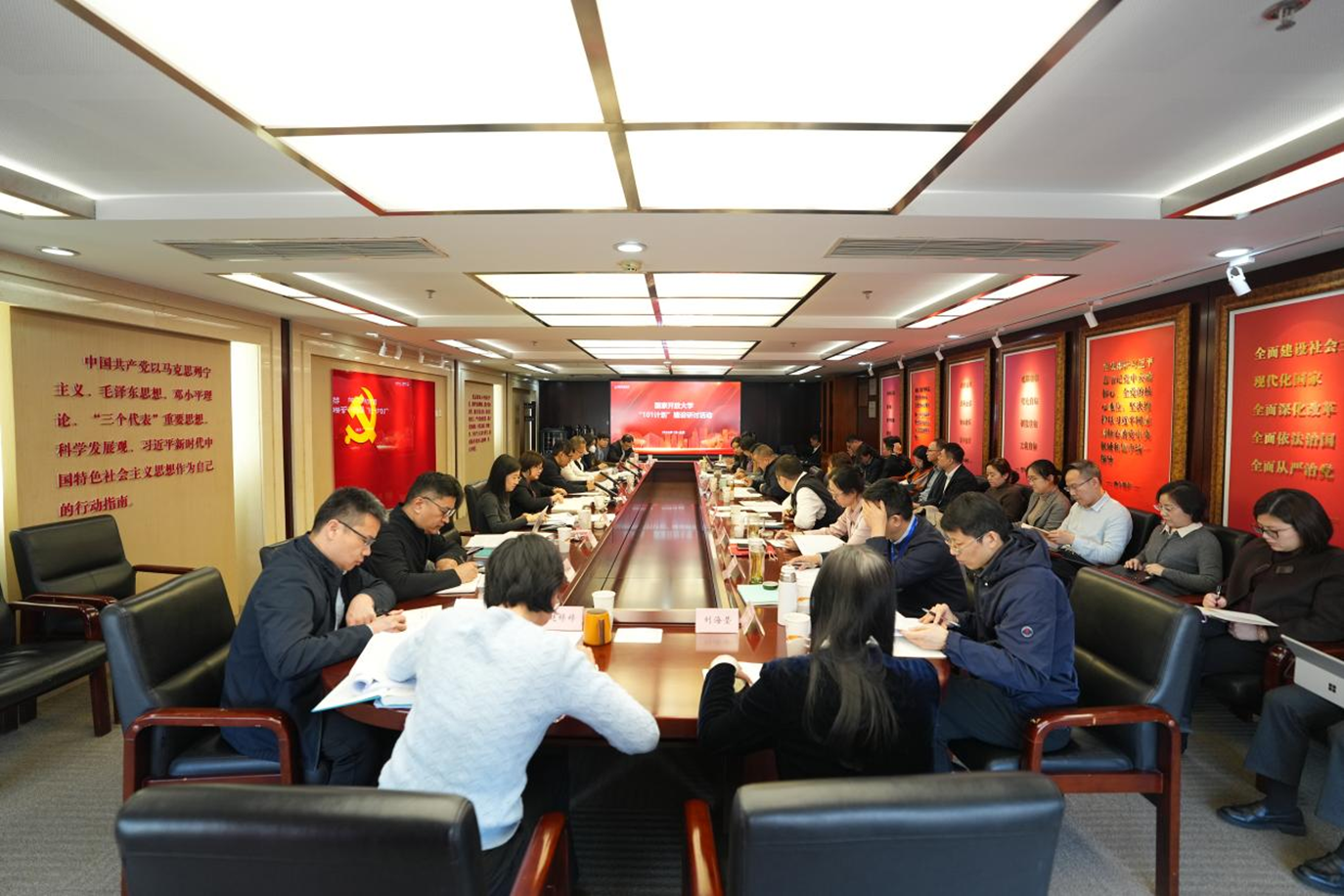
 Beijing, 26 January 2026 – The Open University of China (OUC) held a seminar on the development of Open Education "101 Plan". The event aimed to implement the national education digitalisation strategy, execute the university's "Implementation Opinions on the Comprehensive Reform of Education and Teaching in Open Universities through Digital Intelligence Empowerment and Integrated Coordination", plan for the strategic transformation of open education, and advance the university’s major development and teaching reform. OUC President WANG Qiming and Vice Presidents LI Song, FAN Xianrui, and XU Mingjun attended the seminar. Heads of academic schools and relevant functional departments were also present.
Photo during the session
GU Xiaohua, Director of the Academic Affairs Department, made a report on the current progress of the "101 Plan". Heads of academic schools presented their initial ideas for the plan's implementation and shared insights on leveraging AI to promote the development of courses, textbooks, faculty, resources, practical training, evaluation, and intelligent platforms.
The seminar focused on two key questions: "Why pursue a strategic transformation in open education?" and "Why implement the Open Education 101 Plan?" Participants emphasised that a strategic transformation in open education is essential for achieving high-quality development. Moving forward, open education must leverage institutional strengths and aggregate systemic advantages, mobilise resources from the education system and high-quality societal assets, and ride the momentum of digitalisation to become the "main platform" and "cornerstone" for meeting national lifelong learning needs. Advancing the "101 Plan" was highlighted as a necessary requirement for the strategic transformation of open education and for building a new ecosystem of high-quality development.
The seminar defined the reform requirements for advancing the "101 Plan". Firstly, to focus on training applied talent guided by job competency needs, aiming to enhance lifelong vocational skills and promote all-round development. Highlight the "AI + Education" feature, with emphasis on core course development and teaching method reform. Secondly, to build consensus on reform, emphasising systematic approach, collaboration, and innovation. We will encourage diverse development to prevent homogenization, promote the "1+ 1+ n" joint-construction model to pool high-quality societal resources, leverage system-wide strength, enhance industry-education collaboration and emphasise the introduction, adaptation, transformation, and innovation of resources. Thirdly, to stay fully committed to digitalisation and digital-intelligence empowerment, build a robust intelligent teaching platform, and strive for sustained technological breakthroughs. Lastly, we will stablish mechanisms to support reform, including corresponding incentive and sustainable development frameworks.
By Academic Affairs Department
Photo by ZHANG Jun